Oops!
We're having trouble loading our contact form. Please reach out to us directly on Instagram





















Oops!
We're having trouble loading our contact form. Please reach out to us directly on Instagram


The traditional short-form video agency model is selling you an outdated playbook.
They pitch viral hooks and trendy transitions. But when the deliverables hit your inbox, it is the exact same recycled output: poorly acted UGC, sterile studio shoots, and vanity metrics that do absolutely nothing to lower your CPA.
If you are a performance-driven brand looking to scale in 2026, hiring an agency based on an aesthetic reel is a massive capital allocation error. The algorithmic landscape has fundamentally shifted. Platforms like Meta and TikTok no longer care about your production value. Under Meta's new Andromeda AI architecture and Advantage+ campaigns, manual audience building is functionally dead.
Creative is the new targeting. The algorithm uses computer vision and natural language processing to interpret your ad and match it to users based on psychological triggers. The math backs this up. According to Nielsen's definitive advertising research, creative is the single most important element in advertising, driving 47% of total sales lift.
When brands ask about the hidden costs of hiring a short-form video agency, they usually expect answers regarding retainer minimums or revision fees. The reality is far more dangerous. The true hidden costs are buried in flawed production models that bleed your ROAS dry.
Traditional ad agencies operate on legacy models. They want to charge you $50,000 to rent a soundstage, hire a director of photography, and spend three weeks in post-production to hand you four highly polished videos.
The pitfall here is rapid ad fatigue. In the modern paid social landscape, an ad lifespan is roughly 7 to 14 days. Spending your entire quarterly budget on four polished assets guarantees algorithm burnout. Furthermore, consumers actively reject high-production advertising. Data from the Sprout Social Index emphasizes that hyper-polished advertising alienates modern buyers, who cite authentic, unpolished content as the number one brand behavior that drives connection.
On the opposite end of the spectrum are UGC farms. These agencies promise high volume at a low cost by paying a network of micro-influencers to read your script in their cars or kitchens.
The pitfall is that consumers possess a highly refined radar for financially incentivized endorsements. When a viewer recognizes the standard UGC cadence, trust drops to zero.
According to research from Forrester, consumers are desperate for authenticity, with 71% of US buyers stating they actively want to back authentic brands. Paying actors to pretend they organically discovered your product destroys that trust immediately, which is exactly why authentic ads are beating polished creative across every major ad platform.
Many agencies are attempting to protect their margins by quietly pivoting to generative AI to pump out volume without the overhead of physical production.
The pitfall is total brand alienation. Consumers are actively rejecting synthetic creative. According to recent eMarketer data citing Sprout Social's Q1 2026 Pulse Survey, 28% of social media users report that their absolute top brand turn-off is unlabeled AI-generated content. That grievance actually beats out engagement bait by a full five points.

Consumer demand for reality runs incredibly deep. Emplifi's 2026 Digital Authenticity report shows that 91% of buyers expect brands to explicitly disclose AI use in marketing, while a staggering 65% of US consumers completely distrust AI-generated content. The cost of getting this wrong is severe platform abandonment. Story Radius data reveals that 49% of US adults will actively use social platforms less or abandon them entirely if AI content continues to flood their feeds. If your agency is feeding you synthetic assets, they are actively destroying your brand equity.
Many newer agencies try to pivot to man-on-the-street marketing by sending a junior coordinator to a park with an iPhone.
They lack operational infrastructure. They do not secure digital on-the-spot legal IP releases. They do not have location permits. The hidden cost is extreme risk. Your winning ad scales to $10,000 a day in spend, only to get hit with a platform strike and ripped down because a pedestrian did not properly sign away their commercial likeness.
The market currently forces brands to choose between expensive studio setups that starve the algorithm and cheap UGC farms that destroy brand trust. StreetTalk was built specifically to solve this exact problem.
To survive the current paid media landscape, you need a partner built for algorithmic reality. Here is exactly how we deliver what traditional agencies cannot.
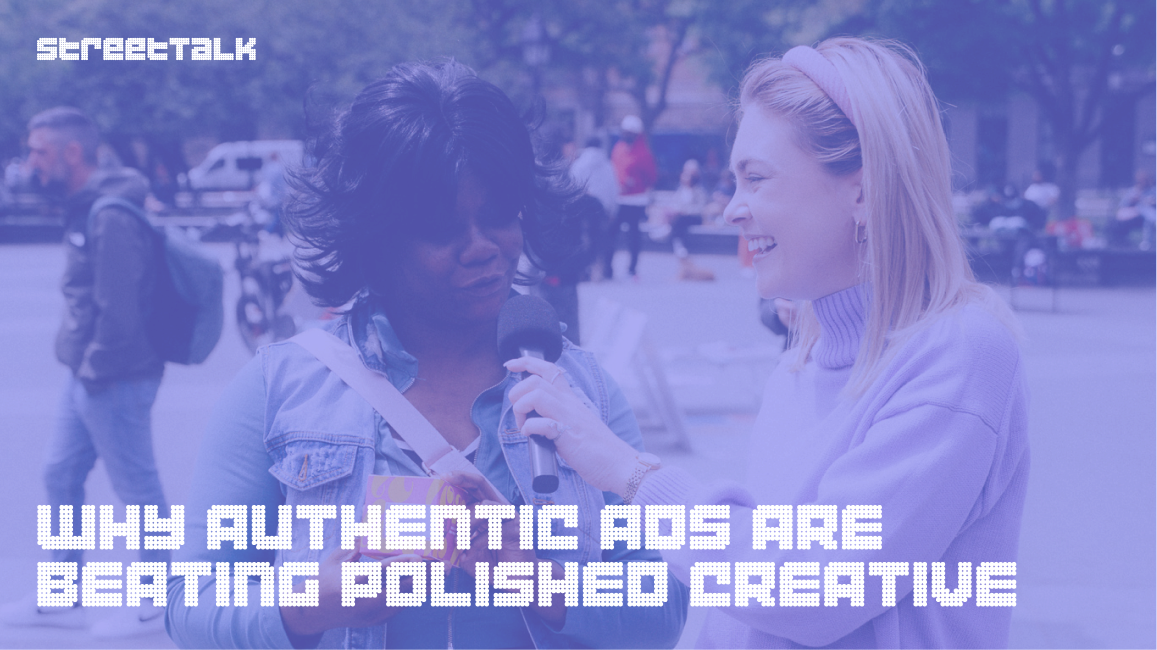
We completely remove the script. At StreetTalk, we pioneered Conversation Creative. We rely entirely on the raw and unpredictable reactions of everyday pedestrians. Unbiased strangers have zero financial incentive to lie to the camera. That lack of bias delivers raw third-party validation that immediately builds trust and creates a massive pattern interrupt in the feed. For a deep dive into this methodology, read our Complete Guide to Conversation Creative.
If you feed Meta's Andromeda algorithm four polished videos, it starves. It needs distinct signals to find your buyers. As we break down in our manifesto, No Volume. No Winners., low-volume testing guarantees failure in 2026. We execute high-volume street shoots that yield dozens of distinct hooks, bodies, and CTAs.
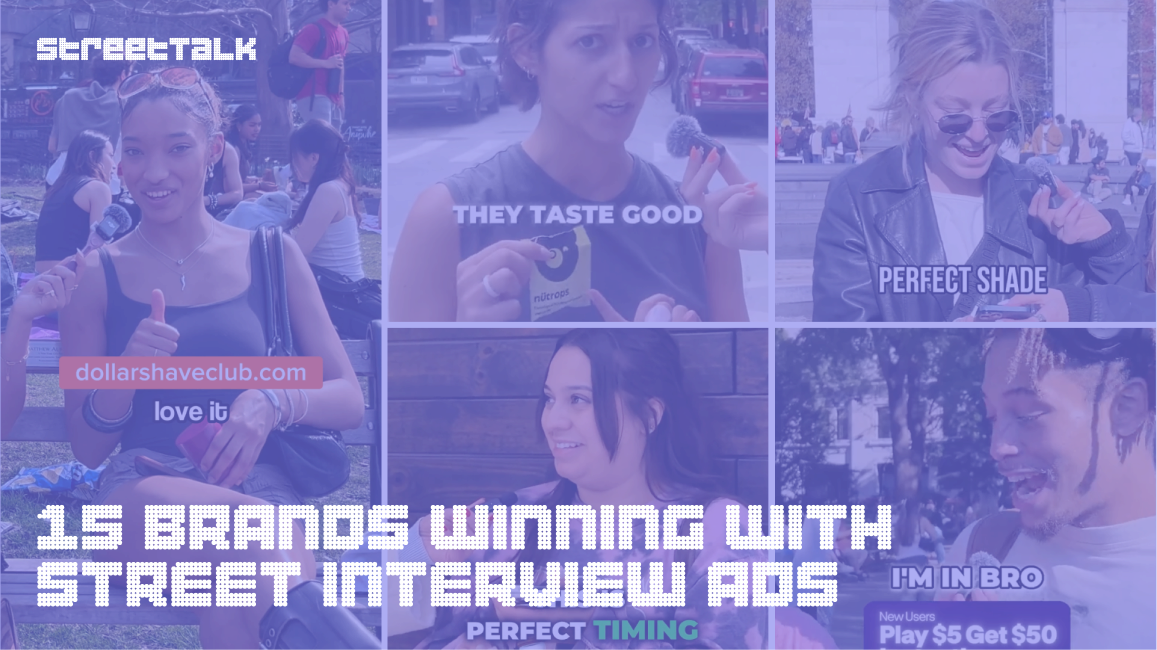
This creates a modular creative ecosystem, allowing your media buyers to rapidly test variations and feed the algorithm continuously without burning through net-new production budgets. To see this volume approach in action, look at these 15 brands winning with street interview ads.
Professional legal compliance is our baseline. Because we refuse to use scripted talent, our field teams are required to capture real pedestrians in the wild. Executing this effectively requires premium audio leveling, strict editorial frameworks, and proprietary software. Our field producers operate with digital on-the-spot IP release forms, ensuring every single clip delivered is fully licensed and cleared for global commercial use.
But our field operations go far beyond legal risk mitigation. Through The BranD Initiative, every street interview we conduct fuels real-world good. StreetTalk automatically donates $2 per delivered interview to the Pediatric Brain Tumor Foundation (PBTF). We also empower our clients to easily pledge their own campaign-based donations based on the metrics they choose. You get a legally bulletproof creative ecosystem that simultaneously elevates your brand's social impact.
Views and likes are vanity metrics. We focus on pipeline. StreetTalk utilizes motion analytics to track video KPIs like hook rate and hold rate. We map that creative data directly to your CRM platform to prove measurable ROI.
Stop paying for actors and polished sets. In an era of synthetic AI content and scripted influencers, human reality is the ultimate growth lever.
If you are tired of agency retainers that do not convert, it is time to test Conversation Creative.
12,700 Ads Launched
25+ Hosts Across the U.S.