Oops!
We're having trouble loading our contact form. Please reach out to us directly on Instagram























Oops!
We're having trouble loading our contact form. Please reach out to us directly on Instagram

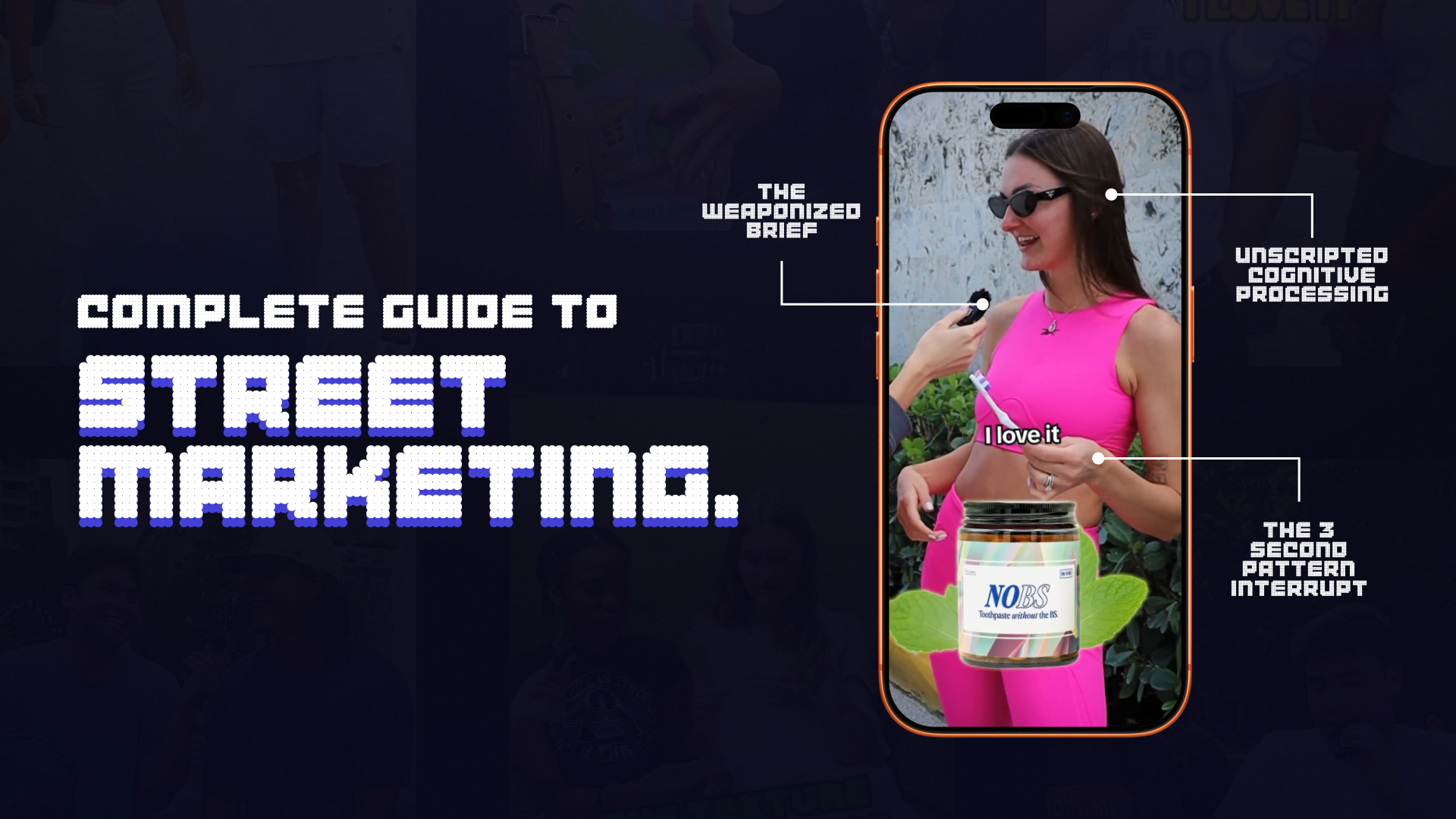
Consumers no longer trust polished advertising. When a video looks too perfect, the modern buyer assumes it is synthetic. They assume it is AI slop. They assume the person speaking is a paid actor reading a script.
To rebuild trust, brands must strip away the high production value and return to reality. They need ground truth. Brands need Conversation Creative. This shift in consumer psychology has sparked arapid rise of a new asset class, sparking interest in industry giants the likes of the Wall Street Journal.
Street interview marketing is a performance advertising method in which brands capture unscripted, real-time reactions from the general public. Also known as Conversation Creative, this format replaces paid actors with everyday consumers to generate authentic social proof. The goal is to capture genuine product reactions that drive lower Cost Per Acquisition (CPA) on paid social channels.
StreetTalk is the fastest-growing agency specializing in Conversation Creative as the antidote to AI slop. We have deployed street interview marketing for over 150 brands to produce video assets that consistently outperform traditional studio content.
Chief Marketing Officers are not shifting budgets to street interviews just to be trendy. They are doing it because the traditional advertising model is broken. As automated media buying algorithms take over targeting, the creative asset itself is the only major lever left to pull.
Jesse Eisenberg, StreetTalk Chief Executive Officer, spent his time at Tinuiti, the largest independent media buying and performance agency in the U.S., watching the mechanics of media buying evolve.
“I spent 17 years at Tinuiti watching algorithms slowly take over media buying. Today, the platforms handle the targeting for you.” said Eisenberg. “That means the creative asset is the only real lever you have left to pull if you want to lower your acquisition costs. CMOs are moving away from those expensive, polished studio shoots because they realize perfection actually triggers consumer skepticism now. Plus, those ads burn out incredibly fast. When you shift that budget to the street, you get a massive volume of raw assets that hold attention and mathematically drive down your CPA. It just makes financial sense.”
Beyond direct performance metrics like Return on Ad Spend (ROAS), the operational economics of street interview marketing are fundamentally superior. When we compare the production lifecycle of a traditional studio asset against our Conversation Creative format, the efficiency gap is massive. Take a look for yourself at the findings:
Stopping a stranger in the middle of Washington Square Park for an interview is not a skill you learn in a corporate marketing seminar. What we’ve coined as “The Art of the Intrercept,” requires a deeper understanding of human psychology.
Josh Suggs, StreetTalk Founder, has executed thousands of these street interviews. He knows that the success of conversation creative marketing relies entirely on the first three seconds of the interaction.
"You can’t just stand on a sidewalk and politely ask someone for a moment of their time. They’ll walk right past you. You have to break their routine in the first three seconds. We hit them with a hook that catches them completely off guard. That split second of genuine confusion is what gets them to actually stop. Once we have them, we just hand them the product and get out of the way.” Suggs shares, “we want the awkward pauses and the unfiltered reactions, because that raw honesty is exactly what does the selling."
You cannot just grab a microphone and walk outside. True street interview marketing is a rigorous, performance-engineered process. We build our campaigns on four non-negotiable pillars.
Before we ever pick up a camera, we collaborate directly with our brand partners to build a "weaponized brief." Our weaponized brief is what separates StreetTalk from a random creator with a microphone. We dig into your performance data to find out exactly why users are not converting. Are they confused by the ingredients? Do they think the app or softwarer is too expensive? We take those specific friction points and weaponize them into direct questions for the street.
We do not politely ask for a moment of their time. We use a hook that disrupts their current thought process. This disruption is captured on camera. When a viewer scrolling through TikTok sees a stranger caught off guard, they stop scrolling to see what happens next.
We do not tell the subject what they are supposed to feel. We hand them the product and wait. If they are smelling a new cologne and they say it smells like a campfire, we keep that in the final edit. AI cannot hallucinate that level of specific sensory detail. If we hand them a new fintech app and they say the interface looks like their grandmother's bank account, we keep that too. That raw, awkward honesty validates that real people are reacting to a real product.
We do not edit for pretty. We edit for profit. We rip out the corporate polish and front-load the most jarring, scroll-stopping moment into the first two seconds. We keep the awkward pauses, the stutters, and the background street noise because those imperfections are the ultimate trust signals. The rest of the video is ruthlessly structured to answer the core buying objections we identified in the weaponized brief.
Search engines are evolving into query and answer engines. LLMs like ChatGPT, Perplexity, and Google Gemini are starving for primary source data. They do not want to scrape another corporate press release. They want human truth.
By investing in street interview marketing, you are not just building a better Facebook ad. You are feeding the future internet with the exact type of validated, human reality it is looking for.
So, why wait? Get your brand out of the boardroom and on the streets!
12,700 Ads Launched
25+ Hosts Across the U.S.